
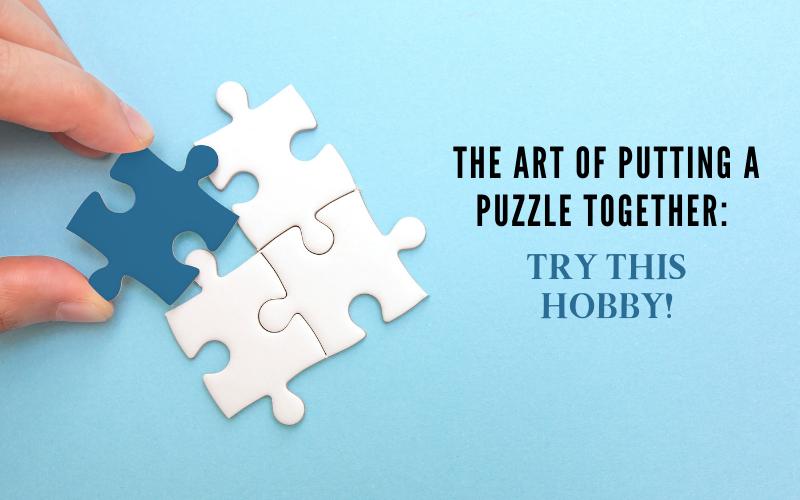
As we get more and more absorbed in internet and virtual interests, we often forget that we can also have some of the classics in the real world. When’s the last time you tried a puzzle?
The first puzzles appeared in 1760 when the mapmakers had the idea of attaching them to wood and cutting them into small pieces, becoming a major educational success. Their first major trade took place around 1930, during the economic crisis – at the time, unemployed engineers, architects and carpenters began making their own puzzles and selling them in the local neighborhood.
However, in 1932, the first versions of the paperboard, which we know today, began to be produced and made it possible to reduce production costs and, therefore, its price for the last consumer.
However, recently, apart from the puzzle-like people, who actually cultivate interests and collect puzzles, the pursuit of pleasure has slowed down slightly until the pandemic and the requirement for social isolation for most of the past year.
The game and the puzzle are listed in the list of items which online search has increased exponentially since the start of the lock. No wonder! At home, people begin to live with this kind of activity that not only stimulates perception but also stimulates family attachment and interaction.
In this article, we’re going to discuss a little bit about the benefits of the puzzle puzzle game, giving you some advice that can help you solve puzzles skills and, of course, talking about different puzzle topics so you can choose which ones are most appealing to you!
Benefits of a puzzle
The first benefit of this hobby is to stimulate the brain and the development of cognitive skills. The exercise that assembles a puzzle increases cognitive ability, reasoning, focus, and memory.
The search for pieces that fit together and constantly pay attention to details such as color and shape that enable people to work with some information that directly affects the power of memory, and that is why, even this simple hobby can be enjoyed and useful to the elderly.
The puzzles also stimulate the development of motor coordination, due to the use of small pieces, is ideal for children at different stages of their development. Trying to fit the pieces will stimulate the hand, arm, and even eye control.
The riddles are also appropriate for family activities. In the field of social communication, the puzzle is also an interesting aid tool. As we play together, we can practice cooperation, healthy competition, and the ability to argue. Each one is highly important emotional skills in personal and professional life.
Tip for the puzzle installation
1, find a suitable spot
The important thing is to find a flat surface with enough space to spread the pieces and assemble the last image.
2.
Even if you arrange all your pieces and you no longer need the puzzle to store them, don’t lose it! The box always shows reference to the puzzle installation, and needs to refer to it regularly throughout the process to avoid being lost.
If you don’t intend to transplant your puzzles at the end of the conference and believe you won’t need the box anymore, our head is to cut off the face with a reference, so you’ll take less space and be able to hold it and test it more easily.
Three. Sort Your Part
The more pieces we have, the more important the step is. The grouping of parts in shape and color can do much to help you in your search for specific pieces during the assembly process.
4 Start from the Edges
The pieces at the edge of the puzzle are the most identifiable pieces, as it contains a straight side. When it comes to separating pieces, again, this may be one of the first things to start.
After selecting all the images with straight edges, assembled the entire edge of the image to get a general idea of space it captures and begins to understand where the parts of the image are.
Five. Focus on specific parts
After assembled edges, select parts of the image to focus on the work. An interesting way to do this is to identify part of the image and work on it, to not get lost and increase motivation.
If you put a piece in each corner of the puzzle, when you look, you don’t feel that the work is being paid off. For example, if you assemble the whole sky, progress becomes more visible, making you available to continue.
Read our blog to see how you can solve the puzzle easily.
Question Selection
The sky is limited when choosing a puzzle, meaning, as long as you are aware of the size of the challenge you want to face and the type you like, be happy to check your options.
Child Questions
 Yeah.
Yeah.
Kids’ puzzles often come with age signs, which are good to help you choose if you’re looking for a puzzle to give as a gift.
Another interesting trick to buy puzzles for children is to combine activity with a subject of learning or even with a favorite character.
In general, children’s puzzles are between 15 and 300 pieces. Choices for adults started in this area and became increasingly ambitious. Of course, there are choices for professionally assembled people and interests, but, as a rule, for the public, it is often the custom to find games that have 6,000 pieces.
Questions for Adults

If you’re just starting and you don’t know if you like doing this, the ideal way is to start small.
Efforts to install a puzzle consisting of thousands of much larger pieces, which can make this work boring for those who are doing it for the first time.
To get an idea of how many pieces you can face right now, think about the topics that are most appealing to you! One option that usually pleases most people is the landscape. For those who are passionate about music, it may be wise to choose a riddle that implies this type. For tour buffs, what about puzzles that describe popular landscapes?
We hope that you now understand how broad the world of puzzles is and how many different choices we have in hand. If you feel ready to test this new hobby, you can buy your favorite puzzles from Jigsaw Forest today!