
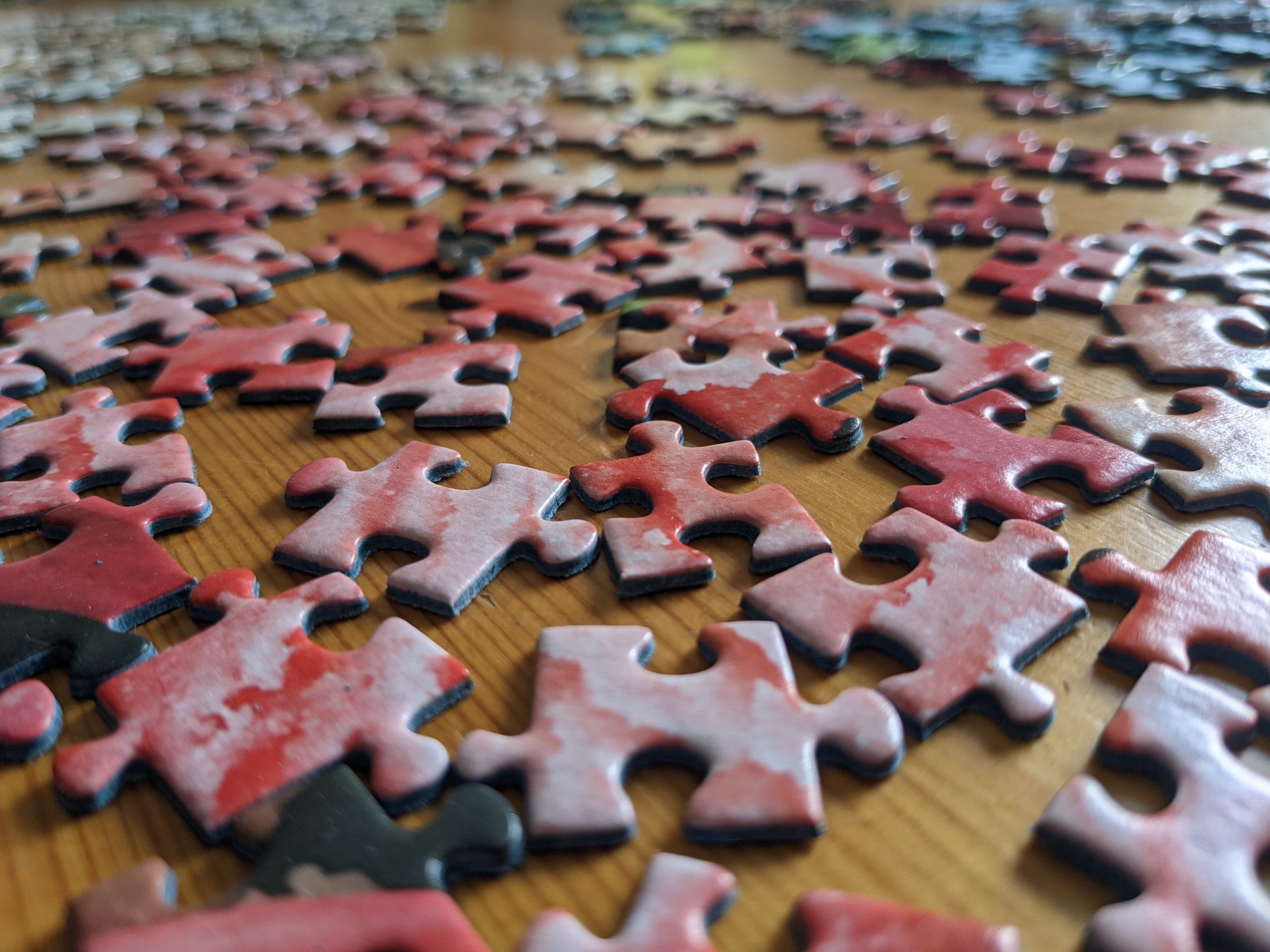
Dumping a brand-new 1,000-piece box onto a table can feel equal parts exhilarating and overwhelming. Staring at a sea of disconnected cardboard shapes, even experienced solvers can momentarily lose their nerve. But whether you are tackling a physical collector’s edition or playing an online jigsaw puzzle on your tablet, assembly is an art built upon proven systems. With the right sorting strategy, workspace lighting, and eye for piece anatomy, any 1,000-piece puzzle can be conquered with smooth, relaxing confidence.
Phase 1: Workspace Ergonomics and the Golden Sort
Before you fit a single pair of pieces together, your preparation determines your success. Clear a flat, spacious surface that allows you to lay out the completed dimensions of the puzzle while still leaving room for sorting trays. Good, diffuse lighting is non-negotiable; harsh overhead glares obscure subtle color shifts, while dim lighting strains the eyes.
The first pass through the pieces should always achieve two goals:
- The Border Patrol: Extract every piece with at least one smooth, straight edge, along with the four corner pieces (identifiable by two perpendicular straight edges). Assemble the outer frame first. This establishes the true physical boundaries of your canvas and provides spatial reference points.
- Color and Texture Grouping: Do not leave the remaining pieces in an unsorted jumble in the box. Sort them into shallow trays by distinct color palettes (sky blue, grass green, brick red) and high-contrast patterns (text, window grids, striped clothing).
Phase 2: The Anatomy of a Piece Cut
When color cues become subtle—such as in large expanses of ocean, dense forest, or monochrome skies—you must shift your attention from color to shape geometry. Standard grid-cut puzzles are built from four basic piece configurations:
- Standard (Two Knobs, Two Holes): The most common connector, with opposing tabs and blanks.
- Three Knobs / Three Holes: Exceptional directional anchors that help bridge difficult sections.
- Four Knobs / Four Holes: Rare, distinctive shapes that instantly stand out during a tray scan.
- Knobs Adjacent: Pieces where two adjacent edges feature knobs, creating right-angle connection opportunities.
Beware of the dreaded false fit—where two pieces seem to interlock along one edge but do not belong together. If a connection requires the slightest physical pressure or leaves an uneven seam, do not force it. True quality cuts always click into place with effortless, flat precision.
Phase 3: The Island Strategy
Novices often make the mistake of trying to grow the puzzle outward purely from the border. This leads to slow, frustrating progress. Master puzzlers build internal islands.
Identify small, high-detail landmarks on the reference image—a bright yellow lighthouse, a cluster of colorful boats, or a distinctive signpost. Assemble these islands separately in your sorting trays. Once an island reaches 10 or 15 pieces, glance at the box cover and slide the entire cluster into its approximate position inside the frame. Eventually, expanding connecting bridges will snap the entire landscape together.
Exploring the World of Exotic Puzzle Variants
Once you have mastered the standard 1,000-piece rectangular grid, test your spatial intuition on modern puzzle variations:
- Panoramic Puzzles: Wide 1:3 aspect ratio landscapes that challenge horizontal scanning.
- Wooden Laser-Cut ‘Whimsy’ Puzzles: Premium heirloom puzzles where pieces are cut into recognizable shapes like birds, trees, animals, and musical instruments.
- Double-Sided and Borderless Puzzles: Murderously difficult novelty puzzles with no edge pieces, identical patterns printed on both sides, and five extra decoy pieces.
- 3D Architectural Models: Sturdy curved and foam-backed pieces that rise vertically to reconstruct famous landmarks like the Eiffel Tower or Empire State Building.
Frequently Asked Questions
How long does it typically take to solve a 1,000-piece puzzle?
For an average adult solver working solo, a 1,000-piece puzzle takes between 6 to 10 hours of focused assembly time, depending on color complexity.
Is it cheating to look at the box image while solving?
Not at all! Referencing the master image is an integral part of visual-spatial deduction. However, solving “blind” without the box is a popular advanced challenge among speed puzzlers.
What should I do when only monochromatic sky or water pieces remain?
Sort the remaining pieces strictly by shape (number of knobs and blanks). Line them up in orderly rows and systematically test candidates one shape category at a time.
Every completed puzzle is a testament to patience, focus, and perspective. Put these masterclass tactics to work on a stunning online jigsaw puzzle on online-jigsaw-puzzle.com today and experience the joy of the perfect fit!